

Whale meat is naturally high in protein and low in fat, and contains unique compounds such as balenine.
It also provides a well-balanced range of nutrients, including iron, vitamins, and taurine.
Research has highlighted its potential benefits not only for athletes and health conscious individuals, but also for children and the elderly.
In recent years, the diverse beneficial qualities of whale meat have drawn renewed attention.

We monitor whale populations through scientific surveys, including international joint research, and manage them under strictly conservative catch limits.
Every whale we take from the sea is handled with the utmost care—from capture to processing—with rigorous hygiene control and quality inspections to ensure safe, reliable products.
The gifts of the sea, carried forward.
Our commitment to sustainable and responsible food sourcing endures.
Every whale we take from the sea is handled with the utmost care—from capture to processing—with rigorous hygiene control and quality inspections to ensure safe, reliable products.
The gifts of the sea, carried forward.
Our commitment to sustainable and responsible food sourcing endures.
-
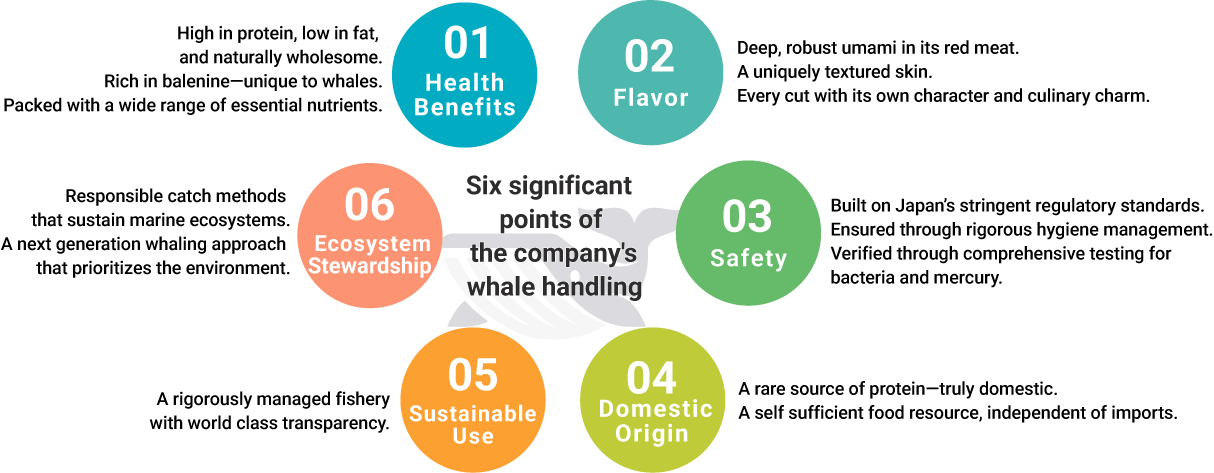
01Health
Benefits -
02 FlavorWhales’ large bodies offer a wide variety of cuts, each with its own character and culinary potential.
From the robust umami of red meat to the distinctive texture of the skin, every part has its own appeal.
Today, whale cuisine extends beyond traditional Japanese dishes into Western and creative cooking, revealing flavors quite different from the whale meat of the past. -
03SafetyWhales caught by our company undergo immediate blast freezing and are processed under rigorous sanitary controls.
Our vessels are equipped with facilities for on board bacterial testing and staffed by trained crew members.
Every whale undergoes mercury testing, and all handling procedures follow Japan’s stringent safety standards.
Unlike many common fish species, whales do not host anisakis(parasites) in their muscle tissue, and whale meat is also known for having relatively few allergens -
04Domestic OriginAll whales caught by our company are harvested within Japan’s Exclusive Economic Zone (EEZ), making them 100% domestically sourced.
Whale meat is a traditional Japanese protein source that supports regional culture and contributes to national food self sufficiency—an increasingly important value in today’s world. -
05Sustainable UseEven after the transition from research whaling to commercial whaling, catch limits continue to be strictly managed under the Revised Management Procedure (RMP), an international framework.
The RMP ensures that population growth always exceeds catch levels, incorporating built in safety factors to keep quotas on the conservative side.
Everything—from allowable catch numbers to the quantity of fishing gear—is tightly regulated, making it one of the most transparent fisheries in the world.
This system ensures the sustainable use of whale resources. -
06Environmental StewardshipManaging whale resources is also an effort to safeguard the health of marine ecosystems.
Appropriate, scientifically managed catches help maintain ecological balance and prevent excessive consumption of prey species.
Since it requires no livestock farming, whale meat is progressively classified as a low-impact, circular dietary resource.
As the world’s only operator of mother ship style whaling, we are able to conduct long term offshore operations without returning to port after each catch.
Our factory ship, the Kangei maru, also employs an electric propulsion system, reflecting our commitment to next generation, environmentally responsible whaling.
Corporate Philosophy
Kyodo Senpaku is committed to sustainable whaling that respects the balance of marine ecosystems.Whales consume roughly 4% of their body weight in food each day, feeding on large quantities of marine life.
When whale populations becomes excessive, it disrupts the balance of the ecosystem.
In a country like Japan, where food self sufficiency is low, marine resources are especially precious.
Guided by a strong belief in protecting both the ecosystem and Japan’s dinner tables, we operate on the principle of taking whales in sustainable, appropriate numbers.
Research Activities
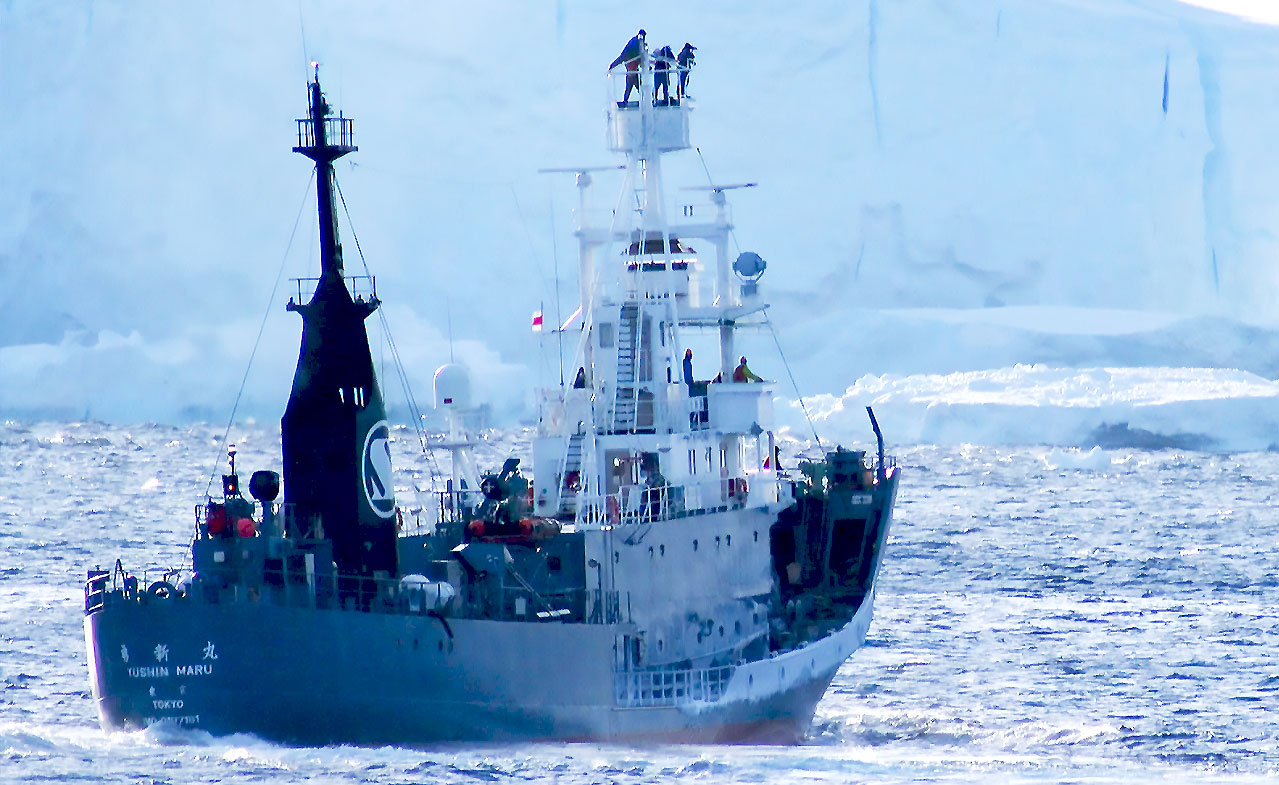
To estimate whale population sizes, we conduct visual surveys, joint research with the International Whaling Commission (IWC), and biological studies aimed at understanding whale ecology.Our technicians and vessels participate in surveys across a broad range of waters—from seas around Japan to the Northwest Pacific and the Antarctic.
When whale groups are sighted, we identify species by body shape and blow characteristics, and record group size, weather, and ocean conditions to build comprehensive datasets.
The scientific and biological data collected through these surveys are submitted to the IWC, contributing to global whale resource management.
Commercial Whaling
With authorization from the Minister of Agriculture, Forestry and Fisheries, we conduct whaling within Japan’s territorial waters and Exclusive Economic Zone.Once captured, whales are transferred from catcher boats to the factory ship, where biological examinations are carried out prior to processing.
The factory ship is equipped with advanced machinery capable of producing a wide range of whale products—from sashimi and canned goods to organ meats.
We are committed to delivering safe, high quality, and delicious whale products in a stable and sustainable manner.

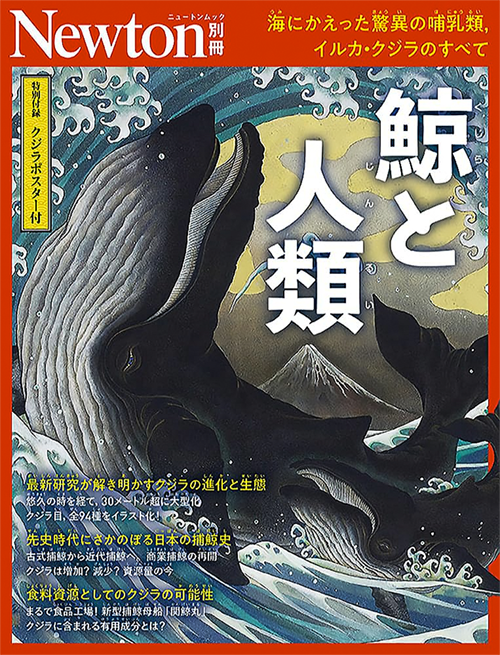
The long awaited special edition "Whales and Humanity" from the Newton science magazine series—now with over 7.7 million copies in print—was released on March 10, 2026.
This book explores everything from whale evolution and extraordinary biology to the long and complex relationship between whales and humankind.
As the operator of the world’s only factory ship whaling fleet, our company provided full cooperation in its production.
The volume includes extensive coverage of our factory ship Kangeimaru and our catcher boats, offering clear scientific explanations of modern whaling practices and resource surveys.
It also highlights the latest research on the nutritional value and health benefits of whale meat.
We invite you to discover this comprehensive look at whales—from their origins to the forefront of contemporary science.
This book explores everything from whale evolution and extraordinary biology to the long and complex relationship between whales and humankind.
As the operator of the world’s only factory ship whaling fleet, our company provided full cooperation in its production.
The volume includes extensive coverage of our factory ship Kangeimaru and our catcher boats, offering clear scientific explanations of modern whaling practices and resource surveys.
It also highlights the latest research on the nutritional value and health benefits of whale meat.
We invite you to discover this comprehensive look at whales—from their origins to the forefront of contemporary science.
*The external link to “Newton” directs to a Japanese-language page.
Please use Google Translate or another translation tool if necessary.
Learn more